

A new year, the same being, but a different path. Or perhaps a new being, the same path? That depends on each being, doesn’t it?
Something similar happens with the Ship of Theseus. And since we’re talking about paradoxes, would you believe me if I told you that tea, in its own way, alludes to it too?
With the Duck Shit article, we wrapped up the sections on cultivars and varieties, along with our introductory journey through the varieties found across the world of tea. As I mentioned at the time (and will continue to emphasize), for someone just beginning to explore tea, everything I’ve shared so far might seem like quite a lot of information. In reality, it’s still fairly basic. Nevertheless, it is more than enough equipment to begin making your way into the world of tea.
My Roman Empire
Since the very beginning of this journal, I've postponed the subject of tea production time and time again.
While many people talk about production as if it were their bread and butter, I have to admit that I tend to take a somewhat more reserved approach. And yes, that does make things a little more complicated.
But I believe it is perhaps one of the most appropriate ways to approach this area: first understanding what we are dealing with before trying to explain what we do with it.
Theseus and his ship
Let’s start with something fairly obvious: to make tea, we need raw material. What kind?
Leaves. Any kind of leaves?
No. We need leaves from the tea plant: Camellia sinensis.
For practical purposes, let’s keep only two wide varieties in mind: Camellia sinensis var. sinensis, primarily associated with China, and Camellia sinensis var. assamica, primarily associated with India.
Of course, there are other varieties and, naturally, an enormous number of cultivars within them. But if we start getting surgical about every classification, we’ll probably never get anywhere.
Now, you might be wondering: “Why all this emphasis on varieties and cultivars? Didn’t we already go over this?”
Yes. But also, no.
Because in the world of tea, very little exists in isolation. Many of its aspects are deeply interconnected: harvest calendars, geographical conditions, varieties and cultivars, pests, fertilizers, machinery, processing techniques, and countless other variables.
It’s not simply a matter of asking for tea and having tea granted unto you. And this is where the Ship of Theseus makes its return.
Because, just like in the paradox, the question isn’t merely what something is, but which elements make it remain what we believe it to be.
In tea, changing the variety, cultivar, location, season, agricultural practice, or even stage of processing can considerably alter the final result.
So, are we still talking about the same tea?
Well… that’s where the fun begins.
“The exam answers”
If you think I’m coming here to write you a 10,000-word thesis for every process involved in every type of tea, you're very much mistaken. You need to read a little more of the journal.
For now, I’ll leave you with the ¿infographics? (if we can even call them that) for the first two types of tea we’ll study.
Take a look at them, get familiar with them, and we’ll talk more about it later, alright?
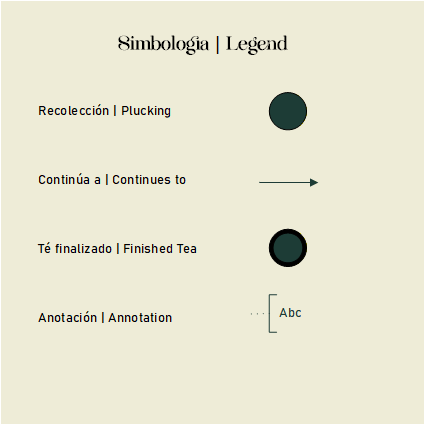
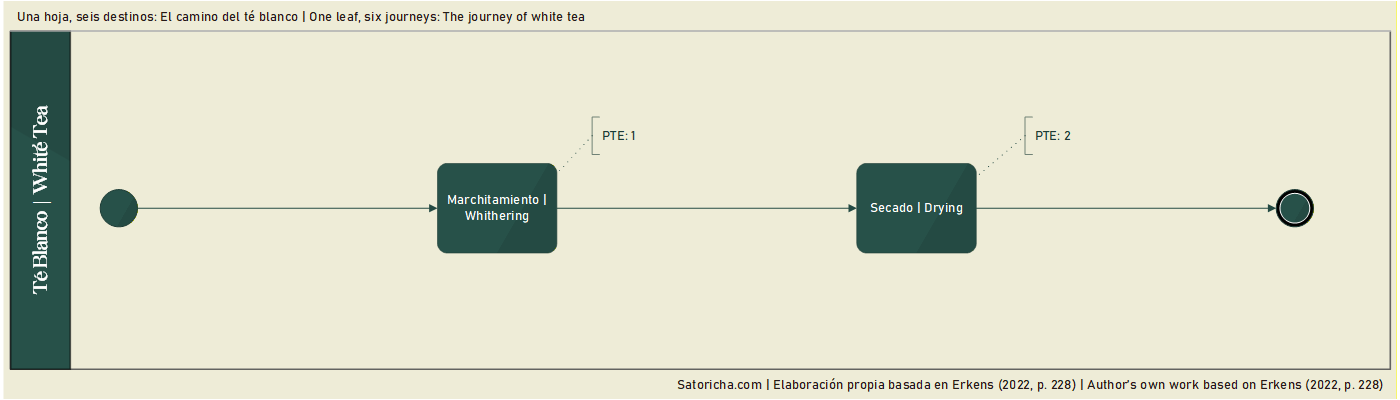
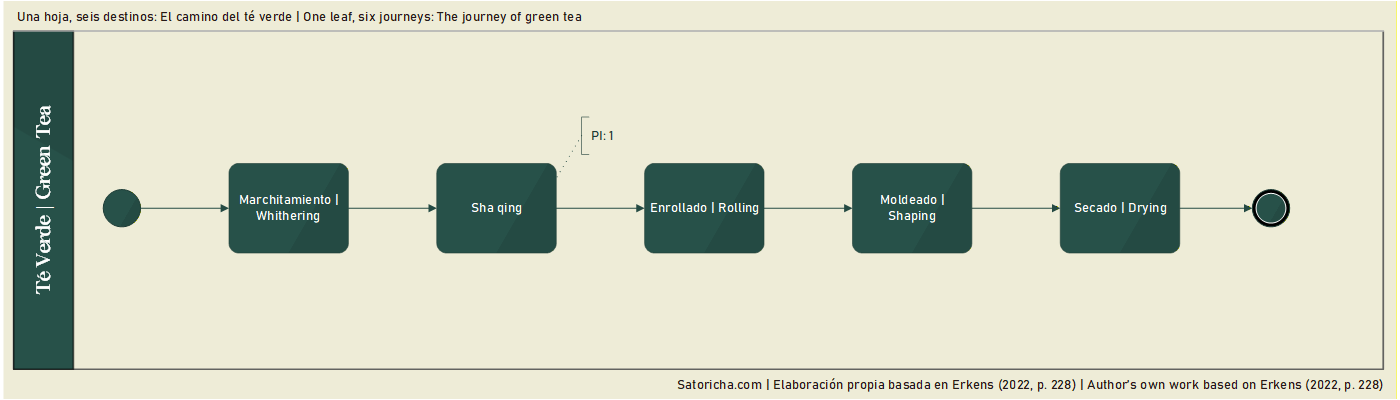
Hello again! Did you get it?
Well, if you think this looks like a state secret, believe me: this was the “easiest” way I found to condense the tea-making processes by type, without going into too much detail or leaving out aspects that could become confusing later.
Confusing? Yes, a little.
But let’s not lose sight of where we’re going. Let’s keep moving, because these are only 2 out of the 6 we have to study.
I’m more than certain I’ve mentioned this at some point already, but it doesn’t hurt to say it again: there are six types of tea: White, Green, Yellow, Oolong, Black, and Dark.
And no, their names don’t necessarily come from the color of their liquor. Although I have to admit, some green teas are indeed pretty green. But hey, it could also be an oolong.
That’s why understanding how tea is made is crucial to telling one from another.
This is where the whole merequetengue of the matter begins. And even more so because, to be completely honest, I don’t even remember what some of the abbreviations I put in my notes back then were supposed to mean.
So, let’s take it one step at a time.
[PTE: 1] Withering
Withering is a process that begins practically from the moment the leaf is harvested or cut. That cut triggers a series of changes and transformations in the leaf’s components.
Depending on the type of tea, this process may take place indoors or outdoors. Depending on the country, region, or even the production style, it can vary considerably.
Broadly speaking, we want the leaf to lose some water and become more flexible, until it reaches a point where it can be handled and shaped without breaking as easily.
[PTE: 2] Drying
As with withering (and, as with many steps in tea production), drying depends heavily on the region and production style.
It can be carried out through exposure to sunlight, hot air, ovens, or other methods.
The goal? To considerably reduce the amount of water present in the leaf.
Have you ever wondered why the tea you buy doesn’t rot like a fresh leaf? Well, precisely because it is dry.
If the leaf retained a considerable amount of moisture, its stability, shelf life, and preservation would drop significantly.
[PI: 1] Sha Qing
Now we arrive at [PI: 1] and [PI: 1 & PTA: 1 (later on)], and this is where I personally tend to be quite cautious.
In books, references, articles, classes, and other sources, this process often appears under the English term “kill-green.
Other authors are a little more careful and prefer to call it de-enzyming or enzyme inactivation.
In my case, I’m particularly grateful to quote Shirley C., who holds a master’s degree in tea science and whose explanation I find useful for understanding what is actually happening.
I have to admit that I have never really liked the English translation “kill the green.” At least when we are making green tea, we are not trying to kill the green, we are trying to keep it! What we are primarily trying to “kill,” if we want to use that word, is enzyme activity.
During shāqīng (杀青), heat is applied to rapidly inactivate enzymes involved in enzymatic oxidation, particularly polyphenol oxidase (PPO). In green tea, we want to interrupt that process very early, helping preserve the relatively green character of the leaves and directing the tea toward the flavor profile we associate with green tea. But fixation is much more than simply switching off enzymes. Water is being lost and redistributed, volatile compounds are changing, grassy aromas are dissipating or transforming, and heat is driving other chemical reactions. It is one of the major stages in which the final aroma and taste of a green tea begin to take shape.
[…]
And shāqīng is not unique to green tea.
In oolong processing, we intentionally allow enzymatic oxidation to develop during the earlier stages.
Once the leaves have reached the desired point, fixation is used to largely halt that progression. In green tea, we close that door very early; in oolong, we leave it open for a while and close it when we have reached where we want to go.
So if I were translating shāqīng scientifically, I would probably use “heat fixation” rather than “kill the green.”
“Enzyme inactivation” describes one of its most important purposes, but fixation encompasses more than that. “Kill the green” is colorful and memorable, and I understand why the literal translation has survived. But especially for green tea, it almost sounds like the opposite of what we are trying to accomplish. We are not killing the green. In many ways, we are preserving it. […] (Chen & Satoricha, 2026)
You might say, “Hey, Sato, you skipped some steps.” No.
We’re simply taking things slowly and doing them properly.
For now, as long as you understand withering, shāqīng, and drying, we’re good. Sure, that’s from a fairly basic perspective, but it’s solid enough to serve as a foundation so we can start sketching out more complex concepts later on.
And why don’t we go through all the types and all their steps at once?
For a fairly simple reason: A lesson should be long enough to spark curiosity, but short enough to spark interest.
Besides, overwhelming you with information has never been the goal. The idea is to make all of this as digestible as possible.
Because learning about tea shouldn’t feel like trying to drink an entire teapot in one gulp. It should feel more like sipping from a little cup, one sip at a time.
Don’t you think?
Satoricha ~
Referencias
Chen, S., & Satoricha. (2026, Agosto). The Chemistry of Flavor Vol. 1 - The girl with three hats. Satoricha.com. https://satoricha.com/en/mijo
Comments